
this is test
If you’re setting up a commercial gym, running a dealership, or buying equipment for a college, corporate wellness centre, or government fitness programme, the manufacturer you choose will decide how your business performs for the next 10 years. A wrong choice means broken cables, rusted frames, and machines standing idle within 18 months. A right choice means equipment that keeps working, members who keep renewing, and a brand you’re not embarrassed to put your name next to.
This guide gives you the exact questions serious buyers ask a gym equipment manufacturer before placing an order — along with the red flags that quietly separate a genuine manufacturer from a trader repackaging imported parts.
Why the Right Gym Equipment Manufacturer Matters
Gym equipment is a long-term, high-value purchase, not a one-time transaction. A multi-station machine or a set of Olympic benches is expected to run 10–14 hours a day for years without failure. When you choose the wrong gym equipment manufacturer, the damage isn’t limited to a few faulty machines — it shows up as:
- Repeated downtime that frustrates members and hurts renewals
- Warranty claims that go unanswered because there’s no real factory behind the brand
- Safety risks from weak welding, thin steel, or untested cable systems
- Poor resale value if you ever upgrade or relocate your gym
- Compliance issues for dealers and institutional buyers who need proper GST invoices and documentation for audits or tenders
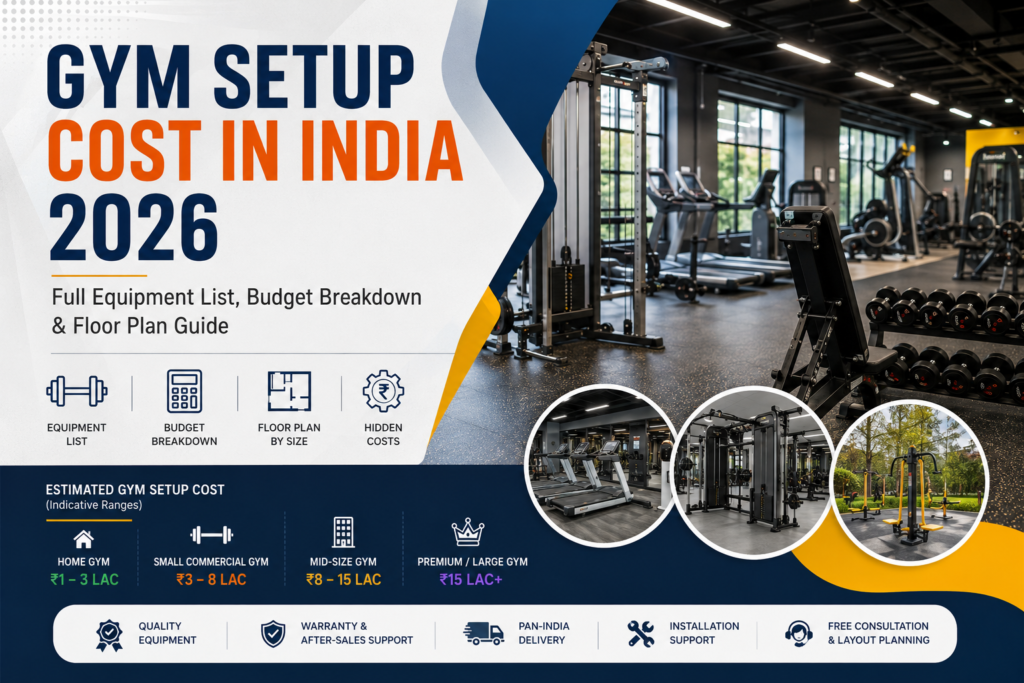
If you’re still working out your total investment, it’s worth reading our detailed breakdown of gym setup cost in India before you start shortlisting suppliers — it will help you judge whether a quote is realistic or too good to be true.
Manufacturer vs Trader vs Importer: Know the Difference
Not every company that calls itself a “gym equipment company” actually manufactures anything. Many are traders who buy from a factory (Indian or overseas) and simply relabel it, or importers who bring in finished machines. Here’s how the three compare:
| Aspect | Manufacturer | Trader / Reseller | Importer |
| Production | Owns the factory; builds equipment in-house | Buys finished goods and resells them | Sources from overseas factories |
| Pricing | Usually most competitive; no middleman margin | Higher; includes reseller margin | Higher; duty, freight, forex added |
| Customisation | Size, colour, branding changed on request | Limited to what’s in stock | Very limited; fixed overseas specs |
| Spare parts | Available quickly from own stock | Depends on original manufacturer | Slow; parts re-imported |
| After-sales service | Direct accountability, faster resolution | Passed back to manufacturer, slower | Often weak or unavailable |
| Lead time | Shorter and predictable | Depends on stock availability | Long — shipping and customs involved |
This is exactly why the first two questions below matter more than any brochure a salesperson hands you.
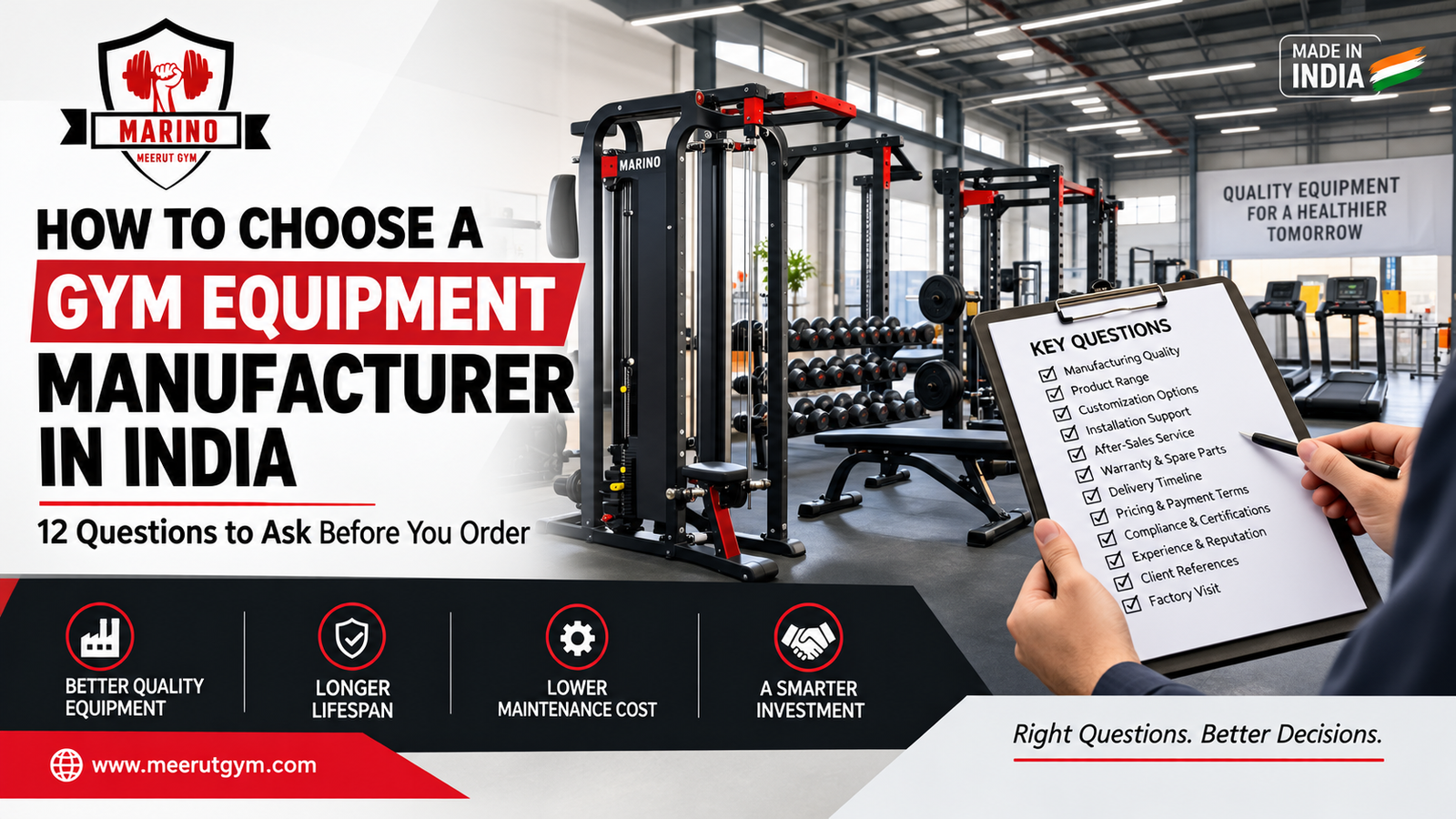
12 Questions to Ask a Gym Equipment Manufacturer Before You Order
Keep this list handy on your next call or factory visit. A genuine gym equipment manufacturer will answer every one of these clearly and in writing — a trader dressed up as a manufacturer usually won’t.
1. How long have you been manufacturing gym equipment, and can you prove it?
Experience in fitness equipment manufacturing isn’t the same as experience in sales. Ask for the year the company was established, its registered business/GST number, and its factory address. A manufacturer with a genuine track record — 10, 15, or more years in the industry — will share this without hesitation.
2. Do you manufacture in-house, or are you reselling or assembling imported parts?
This is the single most important question on this list. Ask to visit the factory in person, or request a live video walkthrough of the production floor — cutting, welding, powder-coating, and assembly. A genuine gym equipment manufacturer will show you this readily; a trader will make excuses or send you stock photos instead.
3. What raw materials and steel grade do you use?
Ask for the pipe gauge (in mm), the grade of steel used in the frame, and the powder-coating process. Cheaper equipment often uses thin-wall tubing that looks identical in photos but fails within a year of heavy commercial use.
4. What certifications and quality standards do you follow?
Reliable manufacturers hold recognised certifications such as ISO, CE, and OHSAS, and follow international dimensional standards for sports and gym equipment. Ask to see the certificates directly — for reference, you can view our own certifications as an example of what a transparent manufacturer should be able to show you.
5. Can I see your full product range across different budgets?
A serious manufacturer usually offers tiers to match different budgets for example our own premium gym equipment range for high-footfall commercial gyms, and our economy gym equipment line for tighter budgets. Being able to compare specifications and pricing across tiers tells you a lot about how transparent a supplier is.
6. What warranty do you offer, and what exactly does it cover?
Get this in writing before you pay a rupee. A warranty should clearly state the duration for the frame, cables, upholstery, and electronic parts separately, along with the process for filing a claim. “One year warranty” with no details attached is not a warranty, it’s a sales line.
7. Can you customise equipment for my space, branding, or institutional requirements?
Dealers and institutional buyers (colleges, government bodies, corporates) often need custom colours, logo branding, or space-saving modular designs. Ask whether customisation is genuinely possible in production, or whether you’re limited to whatever is already in stock.
8. What is your production capacity and realistic lead time?
Bulk and institutional orders can take weeks depending on the manufacturer’s capacity. Ask for a written delivery timeline rather than a verbal promise, and check whether that timeline has any track record of being honoured.
9. Do you provide installation, training, and after-sales service?
Heavy gym equipment needs professional installation and periodic servicing. Confirm whether the manufacturer sends its own technicians, how spare parts are supplied after the sale, and how far their service network reaches — especially important if your gym isn’t in a metro city.
10. What are your payment terms, and do you provide GST invoices?
Institutional buyers, dealers, and franchise owners need proper billing for compliance, audits, and tenders. Avoid any supplier who insists on cash-only payments or refuses to issue a GST invoice — it’s one of the clearest signs of an unregistered or unreliable trader.
11. Can you share client references or case studies?
Ask for references you can actually verify — existing gyms, dealers, or institutions the manufacturer has supplied. Our own client base and background include private gyms, universities, and government bodies, and we’re happy to be checked against them.
12. What is your pricing structure, and is it transparent?
Ask for an itemised quotation that breaks down machine cost, freight, and installation charges separately, rather than one vague lump-sum figure. This makes it far easier to compare suppliers on a like-for-like basis. You can get in touch with our team for a detailed, itemised quote for your gym or dealership.
Red Flags to Watch Out For
Even a short conversation usually reveals whether you’re dealing with a genuine manufacturer. Be cautious if you notice:
- No verifiable factory address, or reluctance to allow a visit or video tour
- Prices far below the market average with no clear explanation
- No written warranty — everything is a verbal promise
- Certifications that can’t be shown or verified on request
- Refusal to issue a proper GST invoice
- Pressure to pay 100% advance before any written agreement or documentation
Quick Due-Diligence Checklist
Before you place an order, make sure you can tick off each of these:
- Factory address and GST/company registration verified
- Answers to the 12 questions above received in writing
- Certifications checked and cross-verified
- Warranty terms clearly stated in the purchase order
- At least one client reference contacted directly
- Delivery timeline confirmed in writing
- Itemised quotation received — no vague lump-sum pricing
For more on shortlisting the right equipment mix for your space, see our guide on choosing the right fitness equipment for your gym.
Why Gym Owners, Dealers, and Institutions Across India Choose Meerut Gym
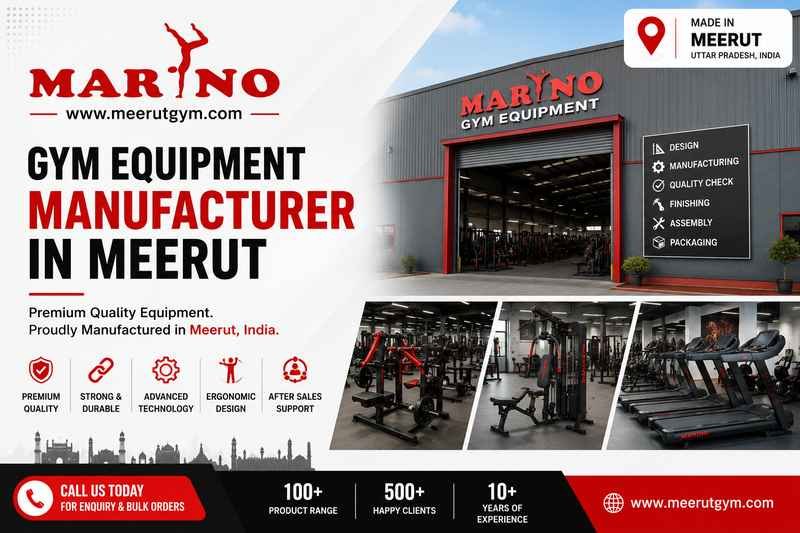
At Meerut Gym & Gymnastic Works, we’ve been manufacturing gym and sports equipment in-house under our MARINO brand for over 15 years. We don’t just sell — we design, engineer, and build every machine at our own production unit, which means we can answer every question on this list with a straight, verifiable answer.
Our range covers commercial, institutional, and home requirements — from premium multi-stations to economy and home gym setups, plus a full line of sports and outdoor equipment. Our client base includes the Sports Authority of India, multiple state governments, and leading universities, and every product is backed by proper certification, written warranty terms, and GST-compliant billing.
Ready to compare specifications and pricing? Download our full product catalogue or contact our team for a customised, itemised quote.
1. What is the difference between a gym equipment manufacturer and a gym equipment supplier?
A manufacturer designs and builds equipment in its own factory, controlling material quality, welding, and finishing from start to finish. A supplier or dealer may simply source finished machines from one or more manufacturers and sell them on. Buying directly from a manufacturer usually means better pricing, faster spare-part access, and clearer accountability for warranty issues.
2. How do I verify if a gym equipment company in India is genuine?
Ask for its GST number and factory address, request a live video tour or in-person visit of the production floor, check its certifications (ISO, CE, OHSAS), and contact at least one existing client for a reference. A genuine manufacturer will not hesitate on any of these.
3. What documents should I ask for before placing a bulk order?
At minimum, ask for a written and itemised quotation, warranty terms in writing, a confirmed delivery timeline, and a GST invoice. For institutional or tender purchases, also request copies of relevant certifications and company registration details.
4. Is it better to buy from a local Indian manufacturer or import gym equipment?
For most commercial gyms and dealers in India, buying from an established Indian manufacturer works out better on cost, customisation, spare-part availability, and after-sales service. Imported equipment can involve longer lead times, higher landed cost due to duty and freight, and slower access to replacement parts.
5. How much should I budget for commercial gym equipment in India?
Budgets vary widely depending on gym size, machine tier (economy vs premium), and the number of stations you need. Our detailed gym setup cost guide breaks this down with equipment lists and price ranges for 2026.
6. Does Meerut Gym provide GST invoices and after-sales service?
Yes. Every order from Meerut Gym is backed by a proper GST invoice, written warranty terms, and after-sales support including installation guidance and spare parts. You can view our certifications or browse our FAQs for more details, or reach out directly for a quote.
Final Word
Choosing a gym equipment manufacturer isn’t a decision to rush through a WhatsApp quote. Ask the 12 questions above, watch for the red flags, and insist on everything in writing. If you’d like a manufacturer that welcomes every one of these questions, get in touch with Meerut Gym today.